Pill-poppers in Aylsham have found a way of recycling those “unrecyclable” blister packs – and it couldn’t be more low-tech.
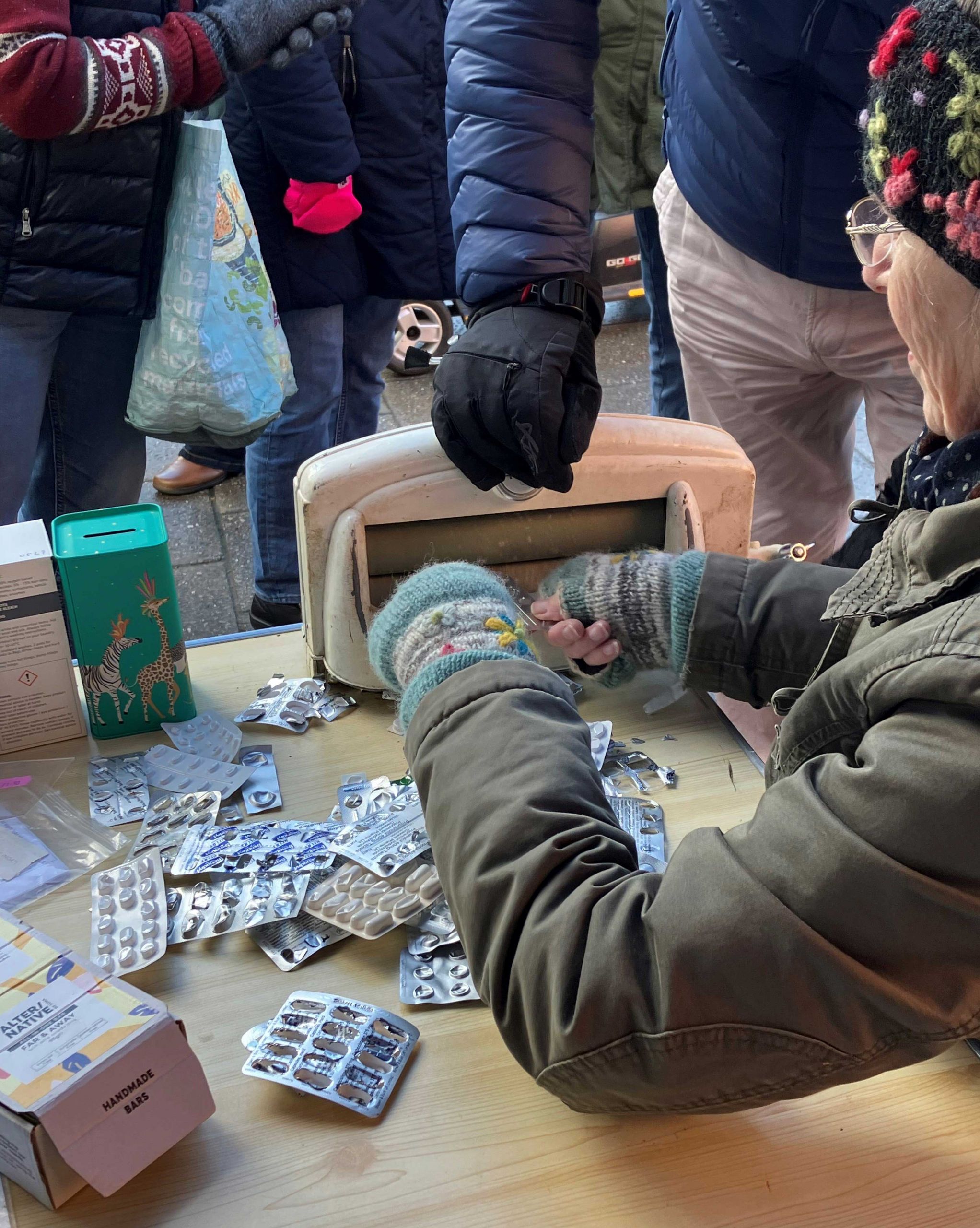
On the first Saturday of the month, Aylsham’s Food & Craft Market attracts shoppers from far and wide but many come just to watch as their bag-loads of used blister packs go through grandma’s old mangle at the Quaker refill stall in the Market Place.
Tablet blister packs cannot be recycled kerbside in your grey bin as they are made from a mixed material of aluminium and plastic. To be recycled they need a specialist process to separate the aluminium from the plastic.
And it is expensive to send them to a private company to process. A single box about the size of a wheelie bin costs more than £100 to recycle.
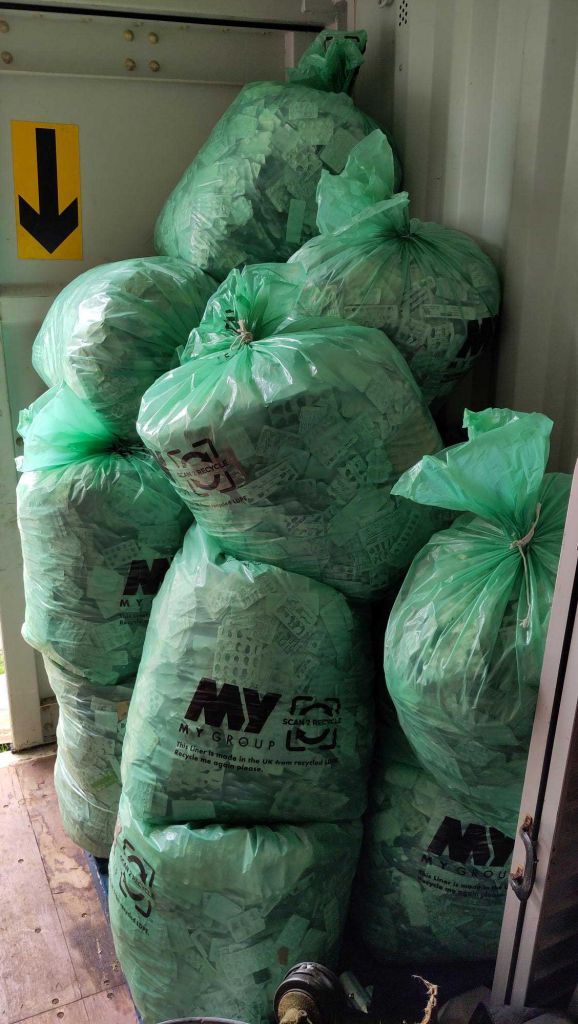
Blister pack sacks ready for collection.
Aylsham Climate Emergency has been recycling medicine tablet blister packs collected by residents since November 2023 following a survey which identified this as the most requested item residents wished to recycle.
There are corporate sponsored recycling schemes, but these require you to take them to Boots and only the Norwich stores run this service. Many Norfolk residents can’t make this journey and so need a local alternative.
ACE Waste began offering this scheme and word soon got out to residents who began donating more a more every month. However, despite generous financial contributions from those who used the scheme, the cost was clearly too high to be financially sustainable.
Michael Dolling, of ACE Waste, said: “Because the cost of recycling these is measured by capacity not weight, we looked at ways to get more packs in each sack. We hit on a solution when we purchased and antique mangle which we fitted to an old workbench. Every month we began mangling them in Aylsham Market place and found this meant we could get up to 1/3 more in each box.
“It also acted as a great talking point with people wondering what we were getting up to.”
Mangling the blister packs reduced the cost from 1.9p per blister pack to 1.4p.
As demand grew, ACE continued to look for ways of reducing the cost as well as successfully applying for grant funding from Veolia Sustainability Scheme and Aylsham Town Council.
In its first year, it engaged the support of Earthglade market stall, Willows Pharmacy, St Michaels Parish Church and Aylsham Quakers and together recycled more than 230kg of blister packs – about 20 wheelie bins full.
“We then negotiated a deal with the processors of this recycling to send them the packs and, with the support of Aylsham Town Council we were able to send them by the pallet. This reduced the cost further,” added Michael.
“Residents continued to financially support the scheme when they brought their blister packs and the scheme grew further. We have now seen blister pack collection double to more than 480kg this year. That’s now four sacks a month just from Aylsham collectors.”
This scheme continues to increase in popularity with other schemes popping up in Hethersett and Wroxham.
However, despite the issue being raised by the local MP and letters going to the global pharmaceutical companies, there is no sign of the recycling of blister packs being comprehensively funded by the people who produce this waste.
Although the Producer Responsibility Scheme places a responsibility on companies to pay a tax to fund the recycling of these items, special dispensation is made for blister packs due to the lack of a suitable alternative.
However, this very fact disincentivises companies to research and develop a better single material solution.
What is needed is a proper, producer-funded, accessible solution to this issue that everyone can utilise.
ACE is in discussion with Broadland District Council to develop a more integrated centralised way to get these packs to the processor in Hull and looks forward to this further reducing the cost of this.
The NHS alone is estimated to use more than 150 million blister packs annually, with additional packs used by private retailers and consumers. This equates to approximately 7.3 million kilograms of C02 equivalent, the same as the carbon footprint of taking 7,300 long haul flights.
Some analysis of the potential reduction in the carbon footprint of medicine tablet blister packs shows that this could be reduced by as much as 70 per cent if a single material packaging solution, a reduction in the overall packaging size and an implementation of a comprehensive recycling program were introduced.
Until then, the bill for this should not have to be picked up by you and I. Global pharma are raking it in.
GlaxoSmithKline made a gross profit of £22.7 billion in the last fiscal year. They can afford to do better than this and government should ensure that they do.